Philosophy Atlas - Graph/Fold/Dossier Knowledge System
Launch Interactive Demo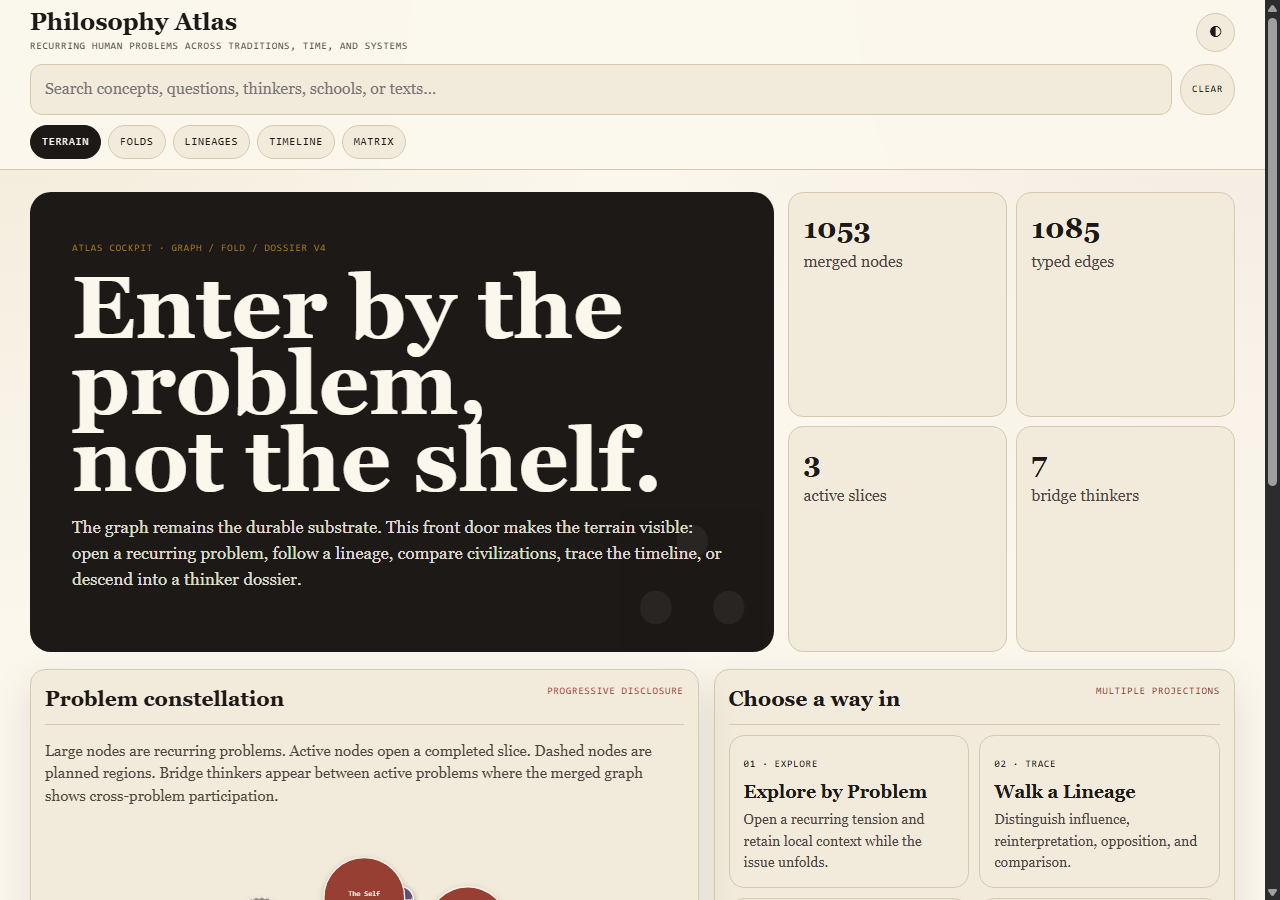
What it is
Open the Atlas Cockpit. Pick your entry point:
- Terrain: a global problem constellation with active and planned regions
- Folds: problem-centered entry cards expanding into issue folds
- Lineages: cross-problem bridge thinkers and typed relationships
- Timeline: aggregated chronology without falsely implying a single transmission chain
- Matrix: current civilization coverage and obvious gaps
Each entry is the same 1,053 nodes and 1,085 edges, navigated differently.
Why it matters
Makes philosophical relationships legible without flattening complexity. Keeps uncertainty visible: comparative relationships are marked differently from documented historical transmission. Generated dossiers show positions, concepts, questions, timelines, texts, and source notes without claiming more certainty than the underlying data supports.
Current shape
- 1,053 governed nodes
- 1,085 governed edges
- 179 cross-problem entities
- 27 shared rich philosopher pages
- 35 slice-specific dossiers
The deepest authored work covers Heraclitus, Parmenides, Aristotle, Socrates. Others are generation targets with graph-generated dossiers marked for expansion.
Architecture
Canonical JSON as source of truth. Build pipeline gated on contract validation. Bag of Holding ingestion projects governed data into graph exports (JSON, GraphML, Cypher). Static HTML generation for durability and portability.
Three active problem slices (Change & Becoming, Self/Identity/Consciousness, Knowledge & Error) use the same fold/lineage/timeline/matrix framework.
What This Demonstrates
Governed data as source of truth for public knowledge infrastructure. Static generation for durable interfaces. Graph thinking that distinguishes lineage, comparison, recurrence, and uncertainty. How to translate structured data into multiple legible interfaces without re-authoring content.
Publication Boundary
Local/generated artifact set. No public repo link yet.