M8str0 - Browser-Native Audiovisual Workstation
What it is
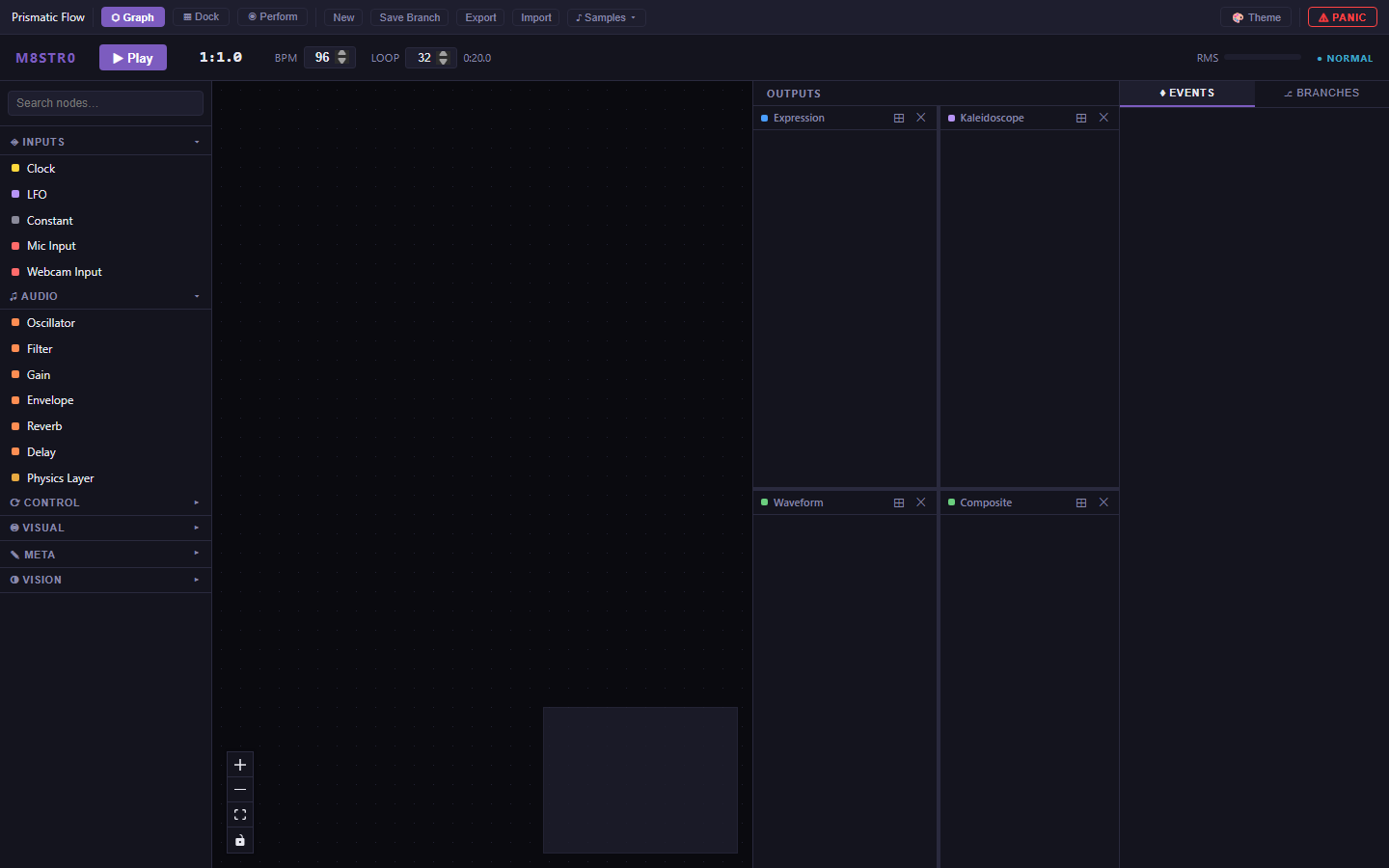
A browser-native modular synthesizer and visual instrument. Build a patch by dragging nodes onto a canvas and wiring their ports — exactly like hardware modular synthesis, but with no plugins, no install, no server.
The unifying idea: a single CV bus connects everything. The same scalar signal that modulates an oscillator’s pitch simultaneously drives a GLSL shader uniform at 60fps. Audio and visuals are one system, not two.
Node types
Input: Clock, LFO, Constant, MicIn, WebcamIn
Audio: Oscillator, Gain, Filter, Reverb, Delay (Web Audio API)
Control: Step Sequencer, Math, Slew smoother, Quantize (snaps to musical scale)
Visual: Expression (curl-noise particle field), Waveform (oscilloscope), Kaleidoscope (mirrored curl-noise), Composite (64-particle ring with ping-pong FBO trails)
Vision: FaceAnalyser — runs MediaPipe face landmark detection in-browser via WASM and outputs 5 biometric CV signals: smile intensity, brow raise, gaze X/Y, face proximity
Architecture notes
Patches save as .m8patch JSON and auto-persist to IndexedDB. GraphRuntime.ts topologically sorts the node graph each tick and rejects cycles before evaluation. A governor feedback limiter with polarity-flip recovery prevents audio runaway. Perform mode hides the editor and expands visual panels full-screen.
What This Demonstrates
- Unified CV routing across Web Audio API params and GLSL shader uniforms
- Topological graph evaluation with cycle rejection at runtime
- MediaPipe face tracking as a live modulation source, loaded on-demand
- Local-first patch persistence without any server or account