Hospital LOS / Bed Flow as a CANON Application
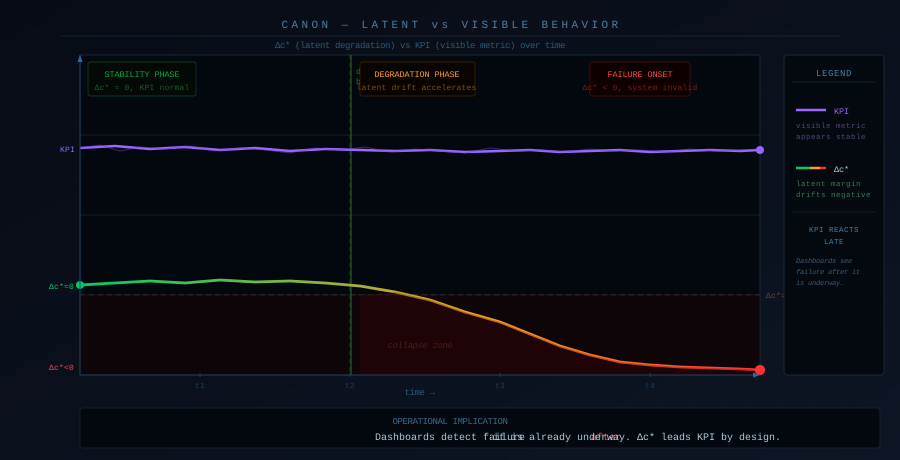
TL;DR: This project applies the broader CANON framework to hospital length-of-stay and bed-flow dynamics. The point is not to build another dashboard. The point is to model whether the unit is still structurally viable before visible throughput failure fully shows up in reported metrics.
Problem
Hospital operations are full of situations where the numbers can look tolerable while the floor reality is already degrading.
Examples:
- census looks manageable, but the unit has no real maneuvering room
- LOS remains near baseline, but hidden boarding and carryover load are accumulating
- throughput appears stable, but the system is spending increasing effort just to remain stable
- one more admission, delay, or blocked discharge pushes the shift into collapse
In plain terms: hospitals often discover strain late.
Diagnosis
Traditional operational views tend to collapse the system into visible outputs:
- occupancy
- LOS
- boarding
- discharge counts
- throughput indicators
Those matter, but they are projections.
They do not directly preserve:
- accumulated prior-shift burden
- shrinking slack relative to real demand
- effort being spent to hold the line
- observation lag and compression across handoffs, dashboards, and summaries
That means two units can look similar on paper and still be in very different structural states.
Treatment
This project maps hospital signals into a latent-state representation rather than treating visible metrics as the state itself.
In the repo’s hospital application layer, the most important practical variables are:
- ΩV — viability margin / slack remaining before the unit loses maneuverability
- Π — regulatory pressure / effort required to maintain feasibility
- H — accumulated load carried in from earlier unresolved states
- L_P — projection loss introduced by lag, batching, summarization, and handoff compression
A reduced retrospective execution form is then used to compute a latent stability signal:
Δc*(t) = 1.0·ΩV(t) − w2·Π(t) − w3·H(t) − w4·L_P(t)
Data-to-state mapping
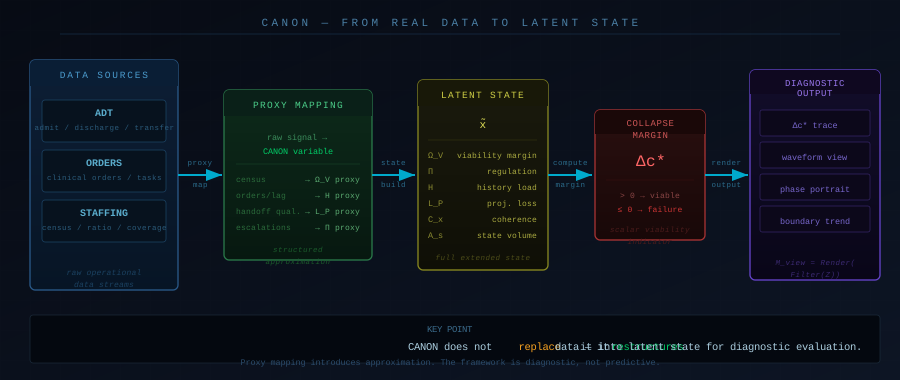
It shows the practical logic:
- start with real operational data sources
- map them into structured latent variables
- compute a latent state signal
- render diagnostic output from the latent state, not directly from raw KPI collapse
That middle translation step is the point. The project is arguing that hospital data becomes more useful when interpreted as evolving state instead of read only as output.
Why LOS is a useful use case
LOS and bed flow are good application targets because they expose a common systems problem:
visible performance is often lagging the real condition of the unit.
A unit can still be technically moving patients while already experiencing:
- rising coordination overhead
- blocked discharge pathways
- depleted flex capacity
- carryover burden from earlier shifts
- growing informational compression between what happened and what leadership can see
That is exactly the kind of environment where a latent-state model has a better chance of being useful than another flat dashboard.
Latent deterioration vs KPI-visible deterioration
latent deterioration should become visible in the model before conventional KPI-visible deterioration becomes obvious in dashboards.
What the repository currently includes for the hospital application
The hospital-specific layer already includes:
- input mapping from hospital signals to CANON variables
- a minimal data schema
- LOS constraint notes
- example cases
- a retrospective evaluation design using public hospital event logs
- execution guidance for a no-leakage evaluation pipeline
What this project is not
It is not:
- a finished production bed management platform
- a validated predictive model
- a claim that one number can fully represent hospital reality
It is a structured attempt to model hospital operations as a constrained system with latent state, rather than as a set of disconnected metrics.
Why this matters in healthcare specifically
Healthcare is unusually vulnerable to projection problems because:
- handoffs compress context
- dashboards summarize what is easiest to count
- throughput metrics are often managerial abstractions rather than direct substrate measurements
- coordination burden is real but unevenly visible
- failure often emerges as a systems property rather than an individual mistake
Relationship to the broader framework
This post should stay explicit about inheritance:
This is one application of CANON, not the totality of CANON.
The broader framework is domain-general. Hospital LOS and bed flow are simply one place where the abstract model becomes concrete enough to inspect.