CANON — Constraint-First Modeling for Systems Under Load
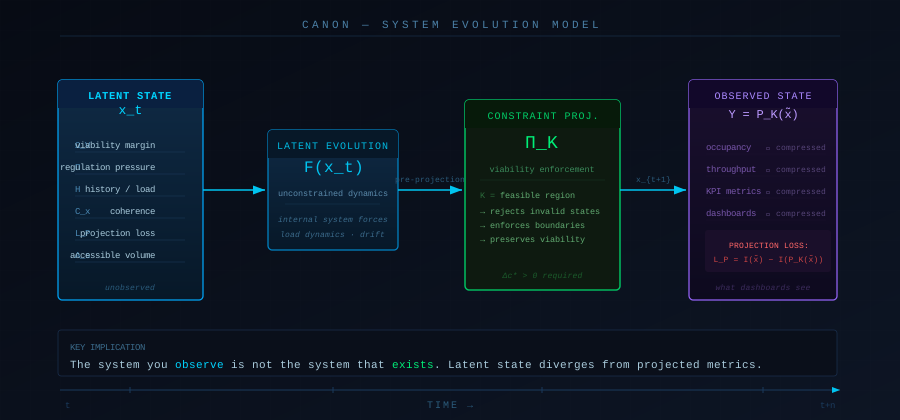
TL;DR: CANON is a constraint-first framework for modeling systems as evolving latent state rather than as a collection of visible metrics. It separates what the system is from what the dashboard can see, then asks the more important question: is the system still viable?
Problem
Many real systems fail late and look stable right up until they do.
That pattern shows up in hospitals, operations, software, organizations, and other environments where:
- throughput still looks acceptable
- KPIs stay near baseline
- no single variable crosses a dramatic threshold
- the system still degrades underneath the surface
Standard dashboards compress state into a few visible indicators. That is useful for reporting, but weak for diagnosis.
Diagnosis
The core issue is projection.
Most measurement stacks do not preserve full system state. They preserve a reduced view of it.
That reduction hides things that matter operationally:
- carried load from prior states
- mismatch between demand and configuration
- loss introduced by aggregation, lag, and summarization
- shrinking viable maneuvering room before visible failure
So two situations can present with similar metrics and still have very different structural futures.
CANON is built around that distinction.
What it is
CANON is:
- a state model, not a score
- a constraint system, not a conventional predictor
- a diagnostic lens, not a dashboard
Its governing question is not:
What are the numbers?
It is:
Is the system still inside a viable state space?
Governing principle
The framework is anchored to constrained latent evolution:
x_{t+1} = Π_K(F(x_t))
Where:
- F(x_t) is the latent evolution of the system
- Π_K is projection or enforcement back into the feasible region K
That matters because the system is defined by what states remain admissible under load, not just by the outputs currently visible to observers.
Core variables
At the practical level, the framework tracks state through variables such as:
- ΩV — viability margin / remaining headroom
- Π — regulatory pressure / corrective effort required to remain stable
- H — accumulated load / hysteresis residue from prior states
- L_P — projection loss / information lost when the system is compressed into observable form
The full specification extends beyond those variables, but these are enough to make the intuition legible: visible stability can coexist with latent degradation.
Treatment
CANON introduces a two-layer view of the world:
- Latent state — the actual evolving system
- Observed state — the reduced representation produced by measurement, reporting, and dashboards
It then formalizes the gap between them.
That gap is not treated as noise. It is treated as part of the system.
System flow
This is the cleanest entry point into the framework.
Top layer: latent evolution.
Middle boundary: feasibility / viability constraint.
Bottom layer: projected metrics.
The key claim is simple: the system you observe is a compressed projection of the system that exists.
Viability geometry
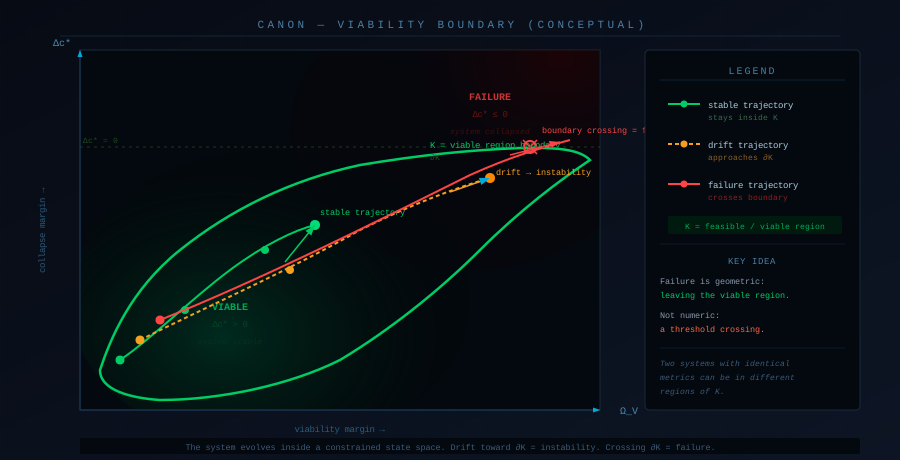
This image matters because it clarifies that failure is not just a scalar threshold event.
A system can drift toward the edge of viability long before any visible metric looks dramatic. In CANON terms, collapse is geometric before it becomes obvious.
Latent divergence vs visible metrics
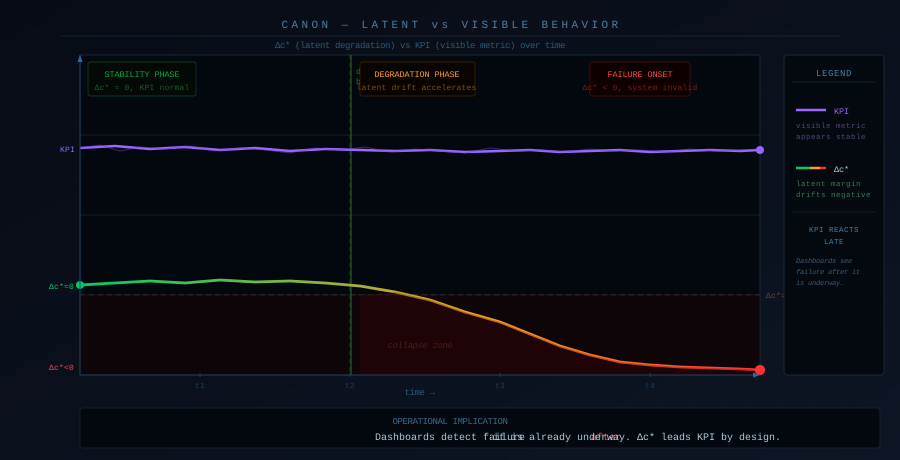
This is the practical payoff.
The chart shows the kind of pattern the framework is designed to identify:
- KPI remains flat or near-flat
- latent stability signal deteriorates earlier
- visible failure appears only after the system has already crossed into a bad region
This is the class of pattern that conventional dashboards tend to miss.
Why this matters
The framework is intended for systems where:
- interpretation is expensive
- measurement compresses structure
- failure is often discovered after it is already operationally underway
- visible performance can be a lagging artifact of deeper state
That includes healthcare, but it is not limited to healthcare.
The broader claim is that many modern systems are managed through compressed representations that are good for reporting and weak for preserving truth under load.
Current repository scope
The repository currently includes:
- theory files defining the formal system
- a machine-readable JSON specification
- observability and operator layers
- implementation scaffolding for an interpreter
- worked examples and diagrams
- a hospital LOS / bed-flow application as a concrete domain case
Important distinction: the hospital materials are an application, not the full scope of the framework.