Metis Head - Local Voice Assistant with Bounded Tools
Metis Head explores a practical question: how can a local voice assistant retrieve useful information without gaining broad authority over the systems around it?
What I built
The current application supports typed conversations, browser push-to-talk, local speech processing, and bounded read-only tool routing. Google Calendar, Gmail, and Contacts are optional, account-specific integrations. Bag of Holding and Project Atlas reads use explicit tool allowlists.
Unavailable services report that they are unavailable. Mock providers remain available for deterministic tests; they are separate from configured live integrations.
Where the boundaries sit
- Google access requires the relevant OAuth grant and stays read-only.
- Each browser tab has a bounded conversation session.
- BOH and Atlas tools remain behind server-side gates and allowlists.
- Write requests remain proposals rather than direct changes.
- Credentials, recordings, private commands, and local configuration stay outside the public source export.
The work is in those boundaries: resolving which account a request refers to, refusing ambiguous access, cancelling a voice turn cleanly, and making unavailable connections visible.
Demonstration and evidence
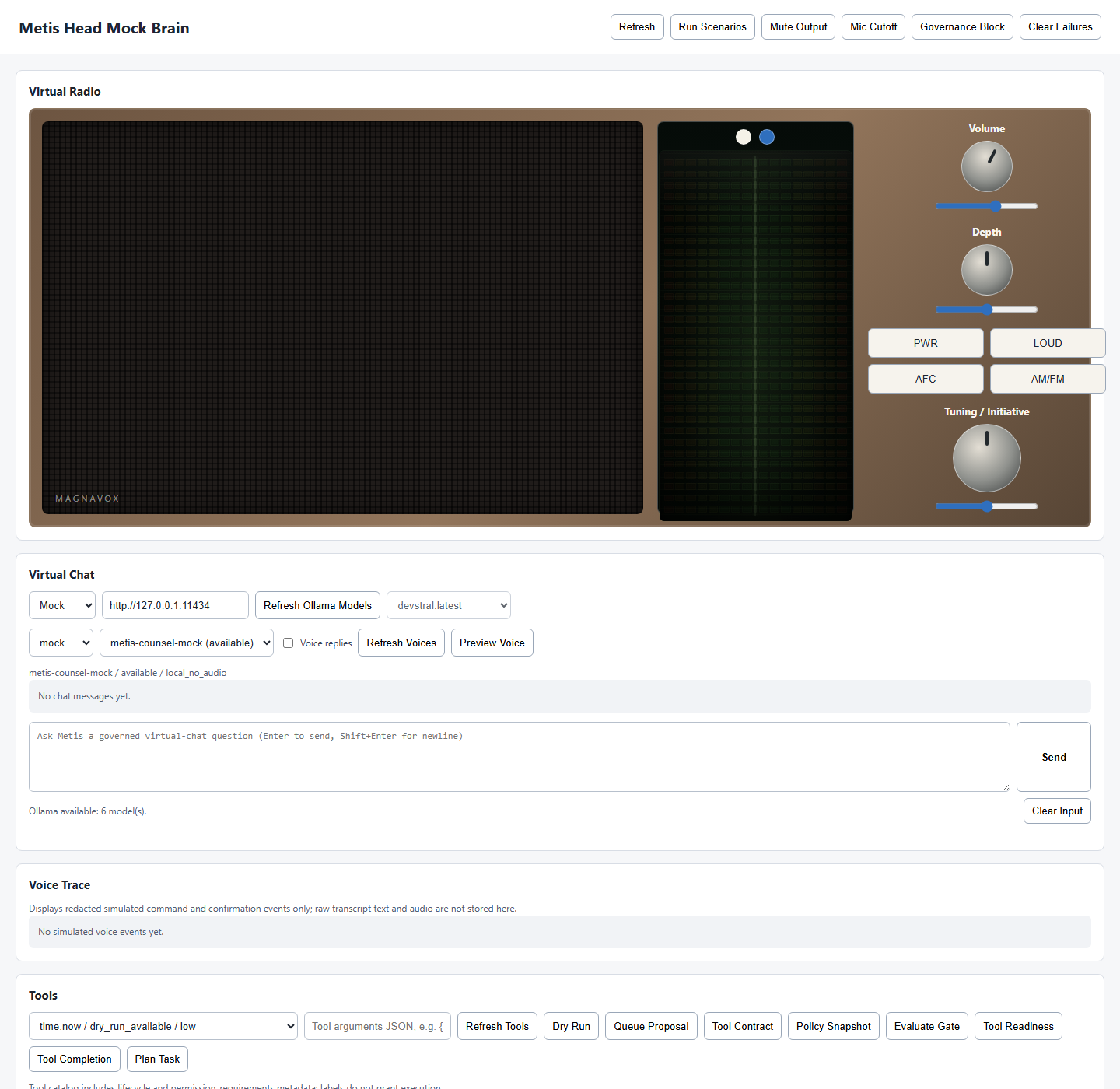
This retained screenshot shows an earlier mock dashboard. It illustrates the review interface; it is not a capture of the current Google connection or browser voice flow. The radio image below is a physical form-factor reference, and the visual representation is a design concept.

The repository README records current implementation and verification evidence. It separates local execution, deterministic fixtures, and operator-confirmed microphone/output checks. Live Google consent remains an operator step.
Current limits
This is a local personal-assistant prototype. Optional integrations require setup and grants. The public project does not establish a production healthcare deployment or validated hardware safety. OpenAI production chat remains deferred in the current implementation.
What this demonstrates
Account-aware retrieval, explicit tool boundaries, cancellable voice workflows, and a clear distinction between a mocked test path and an enabled live service.